
CHILDREN'S HOUSE
The architecture of the ‘Children’s House’ will be a space intended to prevent child malnutrition by providing nutritional material, the development of hygiene and healthcare awareness raising programmes, the organisation of paediatric and social care appointments, housing for at-risk patients, and the training of community nurses, who will guide local families on best practice in relation to prevention and nutrition. The design will be constructed in the context of a humanitarian programme, with a team of volunteers and with the participation of the beneficiary community, it should therefore meet some particular construction need.
The project area is located in the south of Senegal: a western sub-Saharan African country bordered by the Atlantic Ocean, Mauritania, Mali, Gambia, and Guinea. The national population is almost 17 million people, mainly concentrated in the larger urban centres and in the capital. Dakar. The southern region, in addition to the enclave of Gambia, is called Casamance, due to the presence of the river of the same name and is further divided into 3 administrative regions: Ziguinchor, Sedhiou and Kolda, with a total of approximately 1.5 million inhabitants. The central region is Sedhiou, and it is here that the project will be introduced. This is one of the country’s less developed regions, with an average rate of urbanisation of 10%, and an average poverty rate of around 92%. This region has a purely agricultural focus, and the rural villages have an average of 1500 inhabitants. The administrative centre of Sedhiou has approximately 22,000 inhabitants.

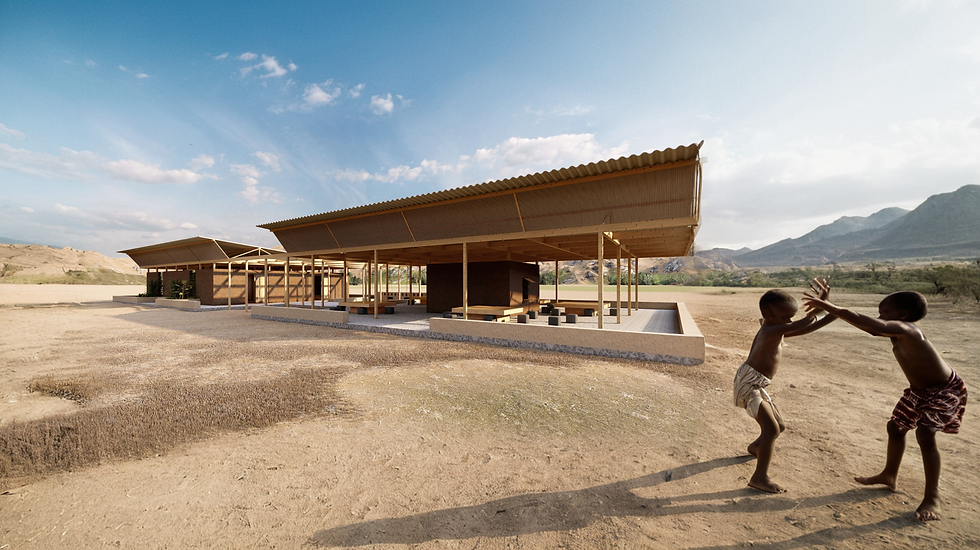
The two volumes spaced apart are altered based on their core purpose; the larger volume must convey the feeling of safety and calmness; hence, it is isolated from the smaller communal area adjacent to it where the children are fed.
The only volume in the dining area consists of the storage room, where dining tables are located around its open space enabling the children to navigate through the open space.

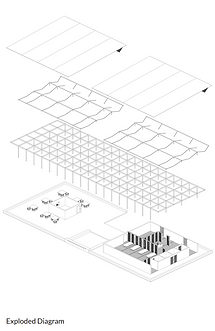
Rather than dedicating an external element on the site for children to play, we have brought the playground into the structure, enabling the children to play within the vicinity of the dining hall and care center; the access emphasizes the experiment of the children and allows monitorization of the children under care. Thus the large corridors that lead the children from the hospitality area to the dining area become a space for children to play.


The primary interior space holding the administration and hospitality area is designed with the flexibility to adapt its layout to fit the special needs based on the number of patients admitted by having moveable wall divisions positioned in a grid-like format that shifts horizontally in the room.


